
Douglas Garrett Gibson's Guide to Efficient Workplace Operations
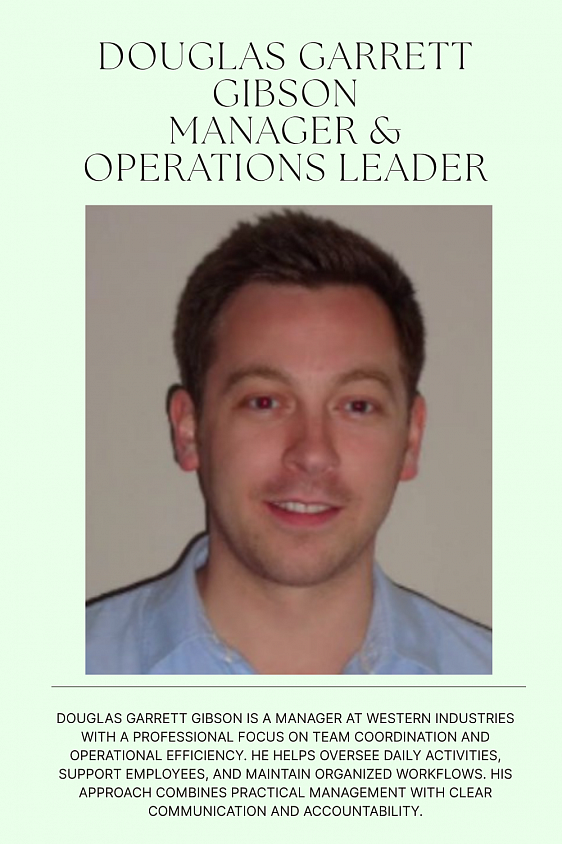
Inside the simple habits that keep Douglas Garrett Gibson's teams running smoothly.
Guide to Efficient Workplace Operations
Running a business smoothly isn't luck — it's a system. Douglas Garrett Gibson, Manager at Western Industries, has spent his career proving exactly that.
Efficient operations don't happen by accident. They come from clear processes, accountable teams, and leaders who show up consistently. In this guide, we'll break down how Douglas Garrett Gibson approaches workplace efficiency — and what you can borrow from his playbook, whether you're managing five people or fifty.
You'll learn what actually drives operational consistency, why accountability matters more than authority, and how small daily habits create long-term business stability.
Why Workplace Efficiency Starts With Structure
Every efficient workplace has one thing in common: structure. Not rigid rules, but clear expectations everyone understands.
Douglas Garrett Gibson believes structure isn't about control. It's about clarity. When employees know exactly what's expected of them, they spend less time guessing and more time producing.
Think about it this way. A team without structure is like a kitchen during a dinner rush with no assigned stations. Everyone's working hard, but nothing's coordinated. Add clear roles, and suddenly the same chaos turns into a well-run operation.
That's the foundation Gibson builds on at Western Industries — defined roles, predictable workflows, and consistent check-ins that keep teams aligned without micromanaging them.
The Role of Accountability in Daily Operations
Here's why accountability matters more than most managers admit: it's the glue that holds efficient teams together.
Without it, even the best-designed workflow falls apart. People miss deadlines. Tasks get duplicated. Small issues snowball into bigger ones.
Douglas Garrett Gibson treats accountability as a two-way street. It's not just about holding employees responsible — it's about leaders being just as answerable for the systems they put in place.
Building Ownership, Not Blame
In practice, this means creating a culture where mistakes get addressed, not buried. When something goes wrong, the goal isn't finding someone to blame. It's understanding what broke in the process — and fixing it.
This approach does two things. First, it builds trust. Second, it encourages employees to flag problems early, before they become expensive.
How Collaboration Improves Operational Consistency
No manager runs a business alone. Efficient operations depend on teams that actually work together, not just alongside each other.
Douglas Garrett Gibson prioritizes collaboration because isolated departments create blind spots. When teams don't communicate, small inefficiencies pile up unnoticed.
Consider a simple example: a sales team promises a delivery timeline without checking with operations first. The result? A broken promise to the customer and a scramble internally to fix it. Better collaboration prevents that entirely.
Practical Ways to Encourage Team Collaboration
A few strategies that support this in real workplaces include:
- Short, regular cross-team check-ins to surface issues early
- Shared documentation so everyone works from the same information
- Open feedback loops where employees can flag friction points
These aren't complicated fixes. They're habits — and habits are what make operations consistent, not just occasionally efficient.
Creating Workflows That Actually Get Followed
A workflow only works if people actually follow it. That sounds obvious, but it's where most efficiency efforts fail.
Douglas Garrett Gibson's approach focuses on simplicity over complexity. Overly detailed processes tend to get ignored because they're exhausting to follow. Simple, logical workflows get adopted because they make people's jobs easier, not harder.
Signs a Workflow Needs Improvement
How do you know when a process isn't working? Watch for these signals:
- Employees regularly skip steps or find workarounds
- The same mistakes keep happening despite training
- Tasks take longer than they should, with no clear reason why
When these patterns show up, it's not a discipline problem. It's usually a design problem. Gibson's method is to revisit the workflow itself before assuming the team needs correcting.
Supporting Employees So Operations Stay Steady
Efficient operations aren't just about processes — they're about people. A workflow can look perfect on paper and still fail if employees feel unsupported.
Douglas Garrett Gibson emphasizes creating an environment where people can actually do their best work. That means manageable workloads, clear communication, and leaders who are genuinely accessible.
Why does this matter for efficiency specifically? Because burned-out, unsupported teams make more mistakes. Support isn't a soft skill — it's an operational safeguard.
Small things add up here: checking in before a project deadline, not just after. Asking what's slowing someone down instead of assuming they're not trying. These habits keep operations steady, even under pressure.
Frequently Asked Questions
What makes operational management effective?
Effective operational management combines clear structure, accountability, and consistent communication — not just efficient processes on paper.
How does accountability improve business efficiency?
Accountability reduces missed deadlines and repeated mistakes by ensuring both employees and leaders take ownership of outcomes and the systems behind them.
Why do some workflows fail even when they seem well-designed? Workflows often fail because they're too complex to follow consistently. Simpler processes tend to get adopted more reliably by teams.
Final Thoughts
Efficient workplace operations don't come from one big overhaul. They come from consistent habits, applied daily.
Here's what Douglas Garrett Gibson's approach comes down to:
- Build structure that creates clarity, not control
- Treat accountability as a shared responsibility
- Prioritize collaboration to avoid operational blind spots
- Keep workflows simple enough that people actually follow them
- Support employees as a core part of staying efficient
None of this requires a complete reinvention of how your business runs. It just requires attention — and a willingness to fix small problems before they become big ones.
So, what's one process in your workplace that could use a little more clarity today?